
Physical vs. mental obstacles
Are you experiencing an obstacle that is keeping you from practicing? Is your obstacle physical, mental intellectual or spiritual? And how can you know which one it is?
Over the years I have experienced a huge list of obstacles to practicing. Most of the time I wasn’t able to name the obstacle until it had lessened. During the period I was experiencing it I just knew I wasn’t happy or was grumpy or people were getting on my nerves. I just felt off.
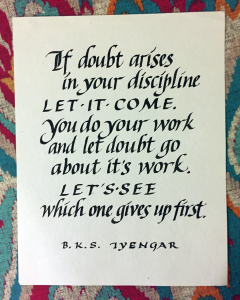
The most consistent and clear obstacle I regularly experience is doubt. Something in the back of my head is saying “who cares about stretching your leg?”, “is it even possible to change the world with yoga poses?” or “aren’t there more important things to do?”
I see now that it’s nearly impossible to be present in the moment, listen for subtle movements of my breath, while simultaneously thinking these nagging questions. My poses do not feel integrated and it’s during times like these that I would be more likely to injure myself. And if I’m not careful my mental obstacles would quickly become a physical one.
Sometimes things go wrong
Sometimes (hopefully not often), something goes wrong and we do hurt ourselves in a pose. When I was newer in my practice I experienced several injuries that I now suspect were likely caused by an unhelpful inner dialogue I wasn’t aware of. But now I know (a little) better and am on the look out for a mental, intellectual or spiritual obstacle that can turn into a physical one.
It’s easy to see how a physical obstacle can keep you from practicing. Your arm hurts so you don’t practice. You have the flu so you stay in bed. But it’s not as easy to see how the other non-physical can keep you off the mat. Or on the mat but not in a fresh and productive way.
You intend to practice before work but oversleep. You say to yourself “I needed my rest” but why did you need rest? Did you stay up late looking at social media? The yoga philosophy lists this obstacle as “sense gratification” or over indulgence. In this scenario I could think I am taking care of myself “because everyone knows we need eight hours of sleep” but I if I don’t admit that I am tired due to indulgence then I am also living in a world of delusion (an intellectual obstacle).
I enjoy staying up late and sometimes indulging–I am not saying it’s bad if you do. But if I want to practice and the indulging is keeping me from doing it then I have to look at myself with an honest lens.
I think the Yoga Sutras of Patanjali are brilliant for making a list of actual obstacles. The nine obstacles are:
- Disease
- lack of interest
- doubt
- pride or carelessness
- idleness
- sense gratification
- living in delusion
- missing the point
- back sliding
When I can pinpoint which of the nine obstacles in causing me problems I am on track to moving past it. For now, anyway. There will always be obstacles and distractions–practice anyway!